Torn your ACL? Why training before surgery makes the difference
A wrong twist on the slopes, a landing after a jump in the sports hall, or a sudden change of direction on the hockey pitch. You feel something snap, the knee swells up and you know straight away: this isn’t good. Sound familiar? A torn anterior cruciate ligament (ACL) is one of the most dreaded injuries for many athletes. Your mind jumps straight to surgery and months on the sidelines.
The good news: an ACL injury is not the end of the road. With the right approach, with or without surgery, you can move with stability and confidence again. Not everyone returns to the same sport at the same level. For some that is the goal, for others it becomes a different sport or a different level, and that can be a very good outcome too. What matters is that your knee fits what you want to be able to do. In this blog we explain what the ACL does, why a period of training before surgery is so valuable, and what your knee should actually be able to do before you have the operation.
What does the ACL actually do?
The ACL runs diagonally through the middle of your knee joint and connects your thigh bone to your shin bone. It stops your shin from sliding forward relative to your thigh and provides stability when twisting and landing. That’s exactly why tears mainly happen in sports with lots of twisting, jumping and braking: football, hockey, handball, basketball and, of course, skiing.
In the winter months we see this a lot more often again, mainly because of skiing.
Not straight to surgery, but training first
After an ACL tear most people want just one thing: to have surgery as soon as possible, so recovery can begin. Completely understandable, but immediate surgery is far from always the best choice. Right after the injury your knee is often swollen, stiff and painful, and your thigh muscles seem to switch off for a while. If you have surgery straight away in that phase, you start rehabilitation with a knee that’s already behind. That’s why more and more orthopaedic surgeons and physiotherapists choose a period of training before surgery, often called prehab.
The idea is simple: the better your knee goes into surgery, the better it usually comes out. A knee that is calm, can fully straighten and goes into surgery with a strong thigh often recovers a lot more smoothly in the first months. You also already know the exercises and the build up, so you don’t start from zero after the operation. Mentally that makes a difference too: you’ve already experienced your knee making progress.
A nice side effect: during this training period it also becomes clear how your knee functions without an ACL. For some the knee turns out to be stable enough for what they want, for others it confirms that surgery is the best step. We make that choice together, in consultation with the orthopaedic surgeon.
What do you want to achieve before surgery?
In this phase we don’t work by the calendar, but towards clear goals. For this we use the criteria from the Melbourne ACL Rehabilitation Guide, a widely used guide for ACL rehabilitation that sets out what your knee should be able to do in each phase. For the phase before surgery, that comes down to:
- Being able to fully straighten your knee, just as far as on your healthy side. A knee that doesn’t fully straighten before surgery is often harder to get straight afterwards.
- Being able to bend your knee well, to about 120 degrees or more.
- Little to no swelling left in the joint.
- Being able to tense your thigh properly, so you can lift your straight leg without the knee sagging.
- Being able to walk normally, without crutches and without limping.
- Regaining as much thigh strength as possible, with the smallest possible difference from your healthy leg.
- Good balance and control on one leg.
How long that takes differs per person. For some a few weeks is enough, for others it takes longer. That’s exactly why we measure it, so you and the orthopaedic surgeon know when your knee is ready.
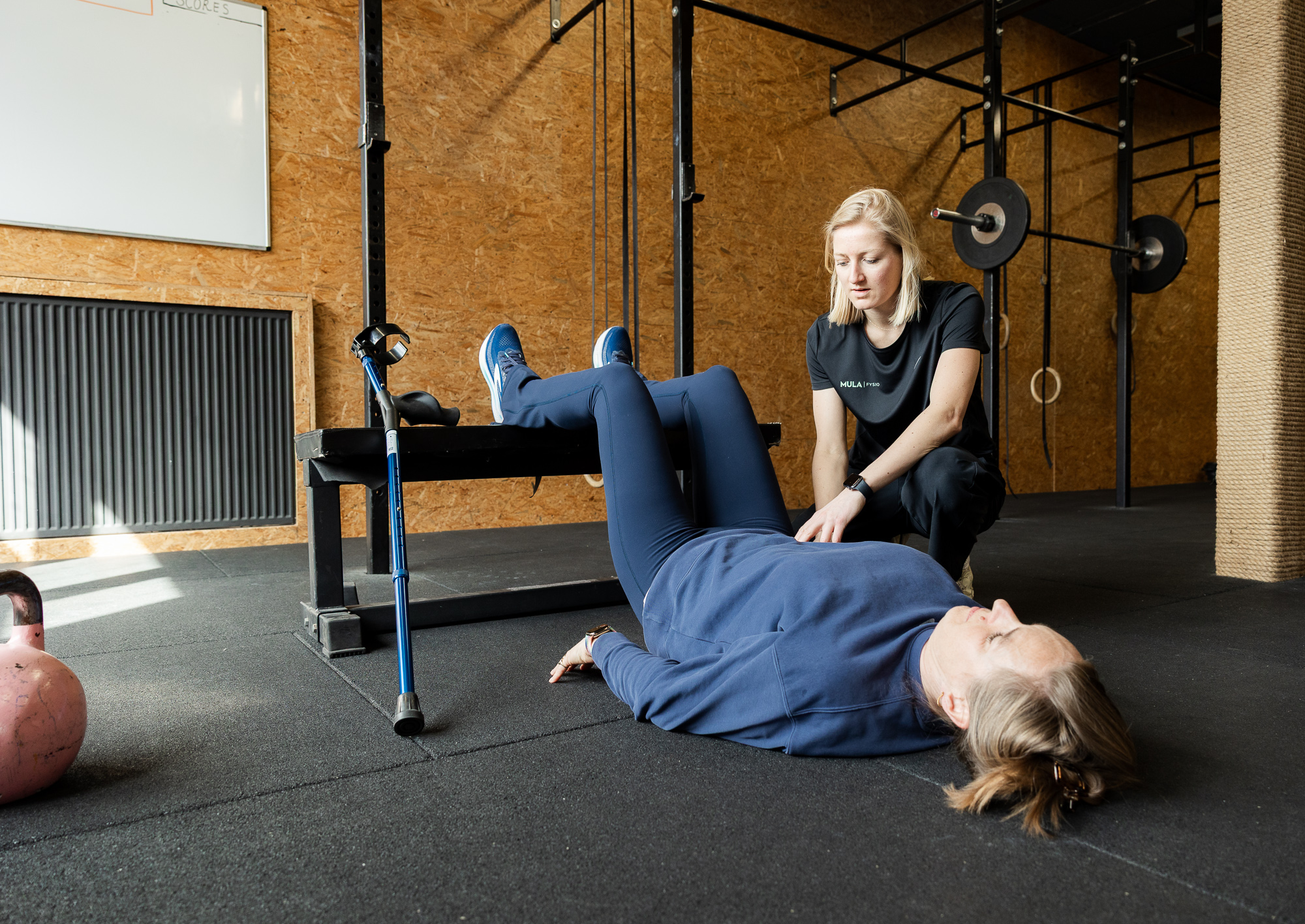
Why rehabilitation makes the difference
Whether you have surgery or not, recovery stands or falls with rehabilitation. A new or healing ACL is only as strong as the muscles around it, and your thigh muscles (the quadriceps) in particular take a big hit after an ACL injury.
After surgery the build up starts again, but from a much better starting point. We build rehabilitation in phases. First we work on swelling again, getting the knee fully straight and switching your thigh muscles back on. Then comes the strength phase, where we train seriously and heavily. Jumping and landing are added early in the process, starting calmly, on two legs and at a low pace. As you get stronger, we build this up step by step to jumping and landing on one leg, sprinting and changing direction, and finally to the movements your sport demands.
That last phase is often skipped or cut short. That’s exactly one of the biggest pitfalls. Your knee feels fine when cycling and running, but isn’t yet ready for the explosive twist of a match.
We don’t just look at the knee itself, but at the whole chain: from your lower back and hip down to your ankle and foot. How you land and turn is partly determined by strength and control around your hip and trunk. With a movement analysis in sport specific situations, we map out where there’s still room to improve.
When are you ready to return to sport?
It’s not the calendar but your knee that decides when you return. Still, time does play a role: a new ACL needs months to become strong enough, even when your knee already feels good.
That’s why at MULA Fysio we measure objectively whether you’re ready to return, using strength tests and hop tests. We don’t just look at the difference between your left and right leg. After an ACL injury your healthy leg often gets weaker too, so a small difference between the legs can give too rosy a picture. That’s why we also compare both legs with normative values for your age, sex and sport. That’s no guarantee, but it’s a much better foundation than returning on feel alone.
The mental side counts too. Many athletes find their knee is physically ready, but they still hesitate in their head when twisting or landing. That’s completely normal, and it deserves just as much attention in the build up as strength. That’s why we also use questionnaires to map out how much confidence you have in your knee and whether there’s still fear of getting injured again.
What can you do yourself in the first weeks?
- Keep moving within what your knee allows. Walking, cycling at low resistance and gently tensing your thigh help keep the knee going.
- Work on getting your knee fully straight. A knee that doesn’t straighten completely makes the rest of the recovery harder.
- Take swelling seriously. Elevating the leg and temporarily adjusting the load help the joint settle.
- Pay attention to recovery outside training: sleep, nutrition and stress directly affect how your body recovers. Not as a side note, but as a full part of the process.
- Get properly examined. Not every swollen knee is an ACL tear, and not every ACL tear needs the same approach.
These are general tips and not a substitute for personal advice. Every knee is different, and what works for one person can have the opposite effect for another.
ACL rehabilitation at MULA Fysio
At MULA Fysio we start with an extensive intake and examination. Together we discuss your goals: do you want to get back on the hockey pitch, back on the slopes, or mainly move through daily life pain free and stable? From there we make a plan together, with clear intermediate steps and measurements, so you know exactly where you stand and what the next step is.
Is surgery planned, or are you considering it? Then we prefer to start training as soon as possible, so your knee goes into surgery in the best possible shape. We measure what your knee can do, agree with the orthopaedic surgeon when you’re ready and then guide you through the entire rehabilitation. Good to know: after surgery, physiotherapy is covered by basic health insurance from the 21st treatment onwards.
Have you injured your ACL, is surgery planned, or do you want to know whether your knee is ready to return to sport? Feel free to email us at info@mulafysio.nl, we’ll be happy to think it through with you.
Written by Guylian Kick, physiotherapist and NVMT-registered manual therapist at MULA Fysio in Amsterdam-Noord. BIG registration: 19922916804.